

Should you abandon your 60/40 portfolio?
The classic blueprint was drawn in a different market. Whether it still protects you depends on inflation, correlation, and what your portfolio has access to.
Three things to hold onto.
Inflation poses a challenge to the traditional stock-bond portfolio. The diversifying nature of the two assets can be sensitive to the level of inflation, which makes diversifying portfolios more critical than ever.
The evolution of portfolio construction can include complementing traditional asset classes with non-correlated sources of return that provide additional diversification and insulation.
When looking for alternatives that can improve portfolio resilience, we believe buyers should look for diversification, durability, and defensiveness.
The 60/40, reconsidered.
The classic investment approach of splitting a portfolio between 60% stocks and 40% bonds has long served as a benchmark strategy for investors. While these percentages can be tweaked based on individual circumstances — like when you plan to retire, how much risk you're comfortable with, and what you're investing for — this basic stocks-and-bonds blend has traditionally been seen as a reliable way to spread investment risk.
This strategy worked well historically because stocks and bonds often moved in opposite directions during economic shifts. When the economy slowed and stocks declined, bonds frequently gained value. This happened because central banks typically responded to economic weakness by lowering interest rates, which made existing bonds more valuable. This pattern meant bond holdings could help stabilize a portfolio when stock markets got rocky.
However, the investment landscape has transformed since the pandemic, challenging the effectiveness of this approach. The chart below shows how over the last two years, the 10-year Treasury has, on average, delivered negative returns on down equity days. That is a stark contrast from the diversifying returns of bonds that many investors relied on from 2000–2007 and 2008–2020.
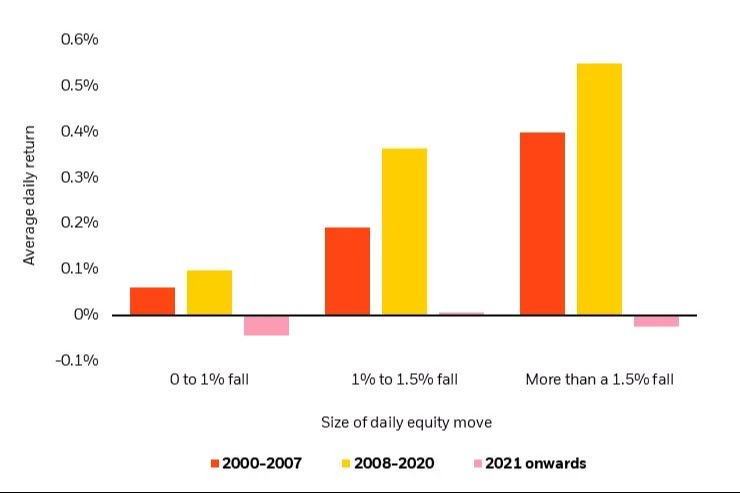
The challenges were well documented in 2022 as stock and bond returns were both significantly negative for the year. In 2023, returns were positive for both stocks and bonds, but so was the correlation. The question needs to be raised: Does the 60/40 really offer efficient diversification?
The answer to that largely depends on the future path of the markets and inflation. Persistent inflation would likely force a shift in monetary policy dynamics that we have come to expect over the last 20 years. If we enter a period of slowing growth, the Fed is less likely to continue on the path of cutting rates. They would likely prioritize achieving their inflation target of 2% over cushioning a short-term downturn in economic growth. As a result, bonds may not offer the same degree of protection in a 60/40 portfolio.

If interest rate cuts get put on hold or eliminated, we may be entering an investment era that will remind us of 2022. While history tells us the 60/40 has fared well over time, the investment landscape is not the same as it was 10 years ago. Over the last decade, we have had incredible advancements in technology and regulation. Through those enhancements, more solutions that were previously reserved for institutional investors have come online to investors meeting accredited or qualified purchaser status.
Who qualifies for institutional access?
Accredited Investor
An individual with an income of more than $200,000 in each of the last two years, or a joint income of more than $300,000 with a spouse or partner in each of the last two years.
Or an individual or joint net worth of more than $1 million, excluding the primary residence.
Qualified Purchaser
An individual that meets specific investment sophistication thresholds set by the Securities and Exchange Commission. This status gives investors access to a wider range of investment options, such as private funds and venture capital funds.
A qualified purchaser has an investment portfolio worth at least $5 million, excluding a primary residence or business property.
While there are other ways to become an accredited investor or qualified purchaser, such as a trust or entity, listed above are the most common ways an individual can be considered accredited or qualified.
The future of portfolio construction splits into two paths.
Path One: The 60/40 2.0
The classic 60/40 could adapt by expanding its components — such as including inflation-protected bonds, international debt, and a wider range of equity markets. This "60/40 2.0" would maintain the simplicity of the original while adding modern safeguards. This is a very difficult task for DIY investors.
Path Two: Broader Diversification
The alternative path involves reducing reliance on stocks and bonds by incorporating other assets that can perform independently of traditional markets. This might include real estate, commodities, private equity, hedge fund strategies, and infrastructure investments. While these alternatives can offer better diversification and potentially higher returns, they often come with trade-offs like higher costs, less liquidity, and more complexity.
The choice between these approaches often depends on investor circumstances. Larger portfolios may benefit more from alternatives due to having the scale to access institutional-quality investments and absorb higher costs. Meanwhile, smaller investors might find better value in an enhanced 60/40 strategy that maintains liquidity and keeps costs low while still improving diversification through more accessible instruments like ETFs focused on different market segments.
The key is recognizing that both traditional 60/40 and alternative portfolios can work — what matters is matching the strategy to the investor's resources, needs, and ability to handle market fluctuations. The future may not be about abandoning the 60/40 entirely, but rather thoughtfully deciding where on the spectrum between tradition and innovation each portfolio should land.
Can your portfolio handle the stress test?
Before deciding which path fits, find out how the portfolio you have now would hold up.
Why alternatives, and why now.
Alternative investments serve as a sophisticated defense mechanism against market volatility, offering unique advantages that extend well beyond traditional portfolio diversification. Their low correlation to stock and bond markets provides a crucial buffer — when markets plunge, investments like private real estate, infrastructure projects, or hedge fund strategies may remain stable or even thrive in the turbulence.
This stability becomes particularly valuable when you are in or nearing retirement. This is when investment missteps can have lasting consequences. Traditional portfolios face the dreaded "sequence of returns" risk — where major market downturns early in retirement can permanently damage a portfolio's ability to provide sustainable income. Alternatives help address this vulnerability by providing multiple sources of returns that aren't tied to market swings. A person nearing retirement with rental property income, infrastructure dividends, or private equity distributions may be able to reduce their reliance on selling stocks during down markets, preserving capital for the long haul.
Additionally, alternatives can offer unique return enhancement opportunities. Private markets may uncover value in ways public markets cannot, whether through direct ownership of businesses, real estate development, or specialized investment strategies. Some alternatives also provide inflation protection through hard assets or contracts with built-in price escalators — a valuable feature for retirees concerned about maintaining purchasing power over decades.
However, it's crucial to approach alternatives with clear eyes. They often require longer holding periods, higher minimum investments, and more complex due diligence. The key is finding the right mix — enough alternative exposure to meaningfully reduce portfolio risk and enhance returns, while maintaining sufficient liquidity for near-term needs. When thoughtfully incorporated, alternatives can transform a portfolio from one that simply hopes to weather market storms into one built to thrive through them.
The end goal isn't just diversification for its own sake, but rather building true resilience into retirement planning. By reducing reliance on traditional market returns and creating multiple paths to investment success, alternatives help provide the stability and confidence investors need to focus on enjoying their golden years rather than worrying about market headlines.
Should you upgrade your investment strategy?
- 1 Are you over the age of 50?
- 2 Do you have over $1,000,000 of investable assets?
- 3 Are you concerned about what a recession will do to your life savings?
Investing in alternatives is not a fit for everyone, but if you answered yes to all three questions above, they may be right for your portfolio. Want to learn more? Schedule an introduction to alternatives below.

Schedule an introduction to alternatives.
Enter your information below and we will reach out to set up a conversation.