

Markets in a Minute - Small Caps Rallying – Can They Keep the Lead?
Small-cap stocks are leading the market in 2026, but whether that leadership lasts will depend on earnings delivery, interest rates, and small business behavior.
For years, markets rewarded size, scale, and technological innovation, leaving smaller-cap stocks trailing their large-cap peers. Recently, that gap has started to narrow as small caps, represented by the S&P 600 index, have shown renewed strength, driven by improving fundamentals. This strength comes at a time when many investor portfolios remain underweight small caps. Can these companies keep the lead?
Key Takeaways
- Earnings: Small-cap earnings are expected to grow ~18% in 2026 and remain strong into 2027.
- Valuation: Small caps trade at a discount to large caps, with investor sentiment still cautious.
- Macro backdrop: Manufacturing is recovering (ISM PMI 54.0), but small business confidence and hiring remain weak.
Why Small Caps Are Leading
After years of playing the underdog, smaller companies have begun to take the lead. Year to date, small caps have returned roughly 19%, compared to about 10% for the S&P 500. That shift has happened even as headlines remain focused on large-cap stocks.
The change reflects improving economic conditions, particularly in more cyclical parts of the economy that tend to benefit small caps. Manufacturing activity has picked up. The ISM Manufacturing Purchasing Managers’ Index (PMI) rose to 54.0 in May, its highest level since May 2022. New orders and production strengthened.
Small caps are typically more sensitive to changes in economic growth and interest rates than large-cap companies. Their revenues come primarily from within the U.S., and their earnings move more directly with economic activity. When growth strengthens, they respond quickly. Conversely, when the economy slows, they feel it faster.
Earnings Growth Accelerating
Small-cap earnings are expected to accelerate meaningfully, a notable shift from previous years. Analysts currently project growth in the high teens to low twenties percentage range over the next two years, a sharp improvement after several years of lagging large-cap earnings.
S&P 600 2025-2027 Estimated Earnings Per Share Progression
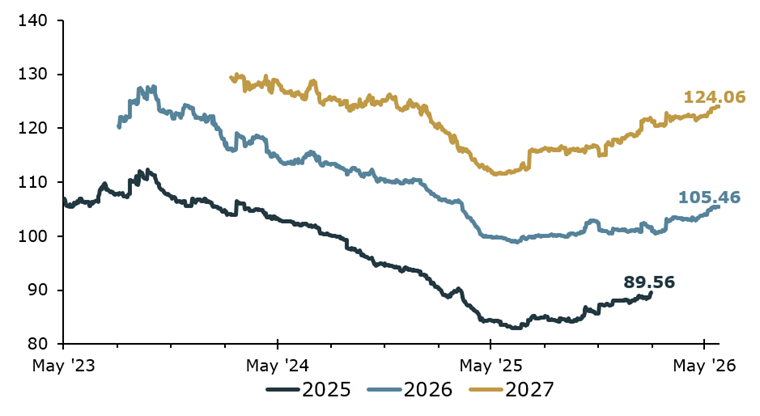
Past performance is not a reliable indicator of current or future results. Estimates may not come to pass. Source: Kestra Investment Management with data from Bloomberg. Data as of June 21, 2026.
Profit growth for smaller companies may get an additional lift from artificial intelligence. For the last several years, AI-related benefits to the bottom line have been concentrated in a handful of names. AI adoption could support earnings by accelerating sales and lowering costs across a broader set of companies, extending benefits beyond the large-cap technology leaders.
Investor positioning adds to the story. After years of small-cap stocks underperforming, many investors have limited exposure to that part of the market and sentiment towards those shares remains cautious. In that environment, even modest improvement in earnings can drive outsized moves in stock prices.Timing the shift is difficult. Waiting for clarity can mean arriving after the move has already started.
What Could Break the Rally
Economic data still tell a mixed story. Industrial activity has improved, but broader small business conditions remain soft. Measures of confidence, hiring, and spending continue to lag. NFIB data show hiring plans at their lowest level since May 2020 and capital spending plans at levels last seen in March 2009.
The next phase depends on whether fundamentals continue to improve:
- Earnings: Sustained leadership requires earnings growth to broaden across sectors, not remain concentrated.
- Small business behavior: Hiring plans are at the lowest level since May 2020 and capex plans near March 2009 lows, signaling caution.
- Interest rates: Higher rates would increase borrowing costs and disproportionately pressure small-cap companies.
Why Valuations Still Matter
Valuation remains a key difference between large and small companies. Small caps trade at a meaningful discount to large caps, reflecting years of underperformance and skepticism about their growth prospects. Lower valuations combined with low expectations and improving fundamentals can provide a strong setup going forward.
From a portfolio perspective, small caps serve a distinct role. Their exposure to domestic growth and their sector mix differ from large-cap indices. That provides diversification, especially when leadership broadens. That diversification has not added value in recent years, but it can become more important if market leadership shifts.
Bottom Line
Small caps are benefiting from economic momentum and rising earnings expectations, but the sustainability of this rally depends on whether earnings growth broadens and financial conditions ease. Without improvement in small business confidence and interest rates, leadership could prove short-lived.
The opinions expressed in this commentary are those of the author and may not necessarily reflect those held by Kestra Advisor Services Holdings C, Inc., d/b/a Kestra Holdings, and its subsidiaries, including, but not limited to, Kestra Advisory Services, LLC, Kestra Investment Services, LLC, Kestra Private Wealth Services, and Bluespring Wealth Partners, LLC. The material is for informational purposes only. It represents an assessment of the market environment at a specific point in time and is not intended to be a forecast of future events, or a guarantee of future results. It is not guaranteed by any entity for accuracy, does not purport to be complete and is not intended to be used as a primary basis for investment decisions. It should also not be construed as advice meeting the particular investment needs of any investor. Neither the information presented nor any opinion expressed constitutes a solicitation for the purchase or sale of any security. This material was created to provide accurate and reliable information on the subjects covered but should not be regarded as a complete analysis of these subjects. It is not intended to provide specific legal, tax or other professional advice. The services of an appropriate professional should be sought regarding your individual situation. Kestra Advisor Services Holdings C, Inc., d/b/a Kestra Holdings, and its subsidiaries, including, but not limited to, Kestra Advisory Services, LLC, Kestra Investment Services, LLC, Kestra Private Wealth Services, and Bluespring Wealth Partners, LLC, do not offer tax or legal advice.